On this page
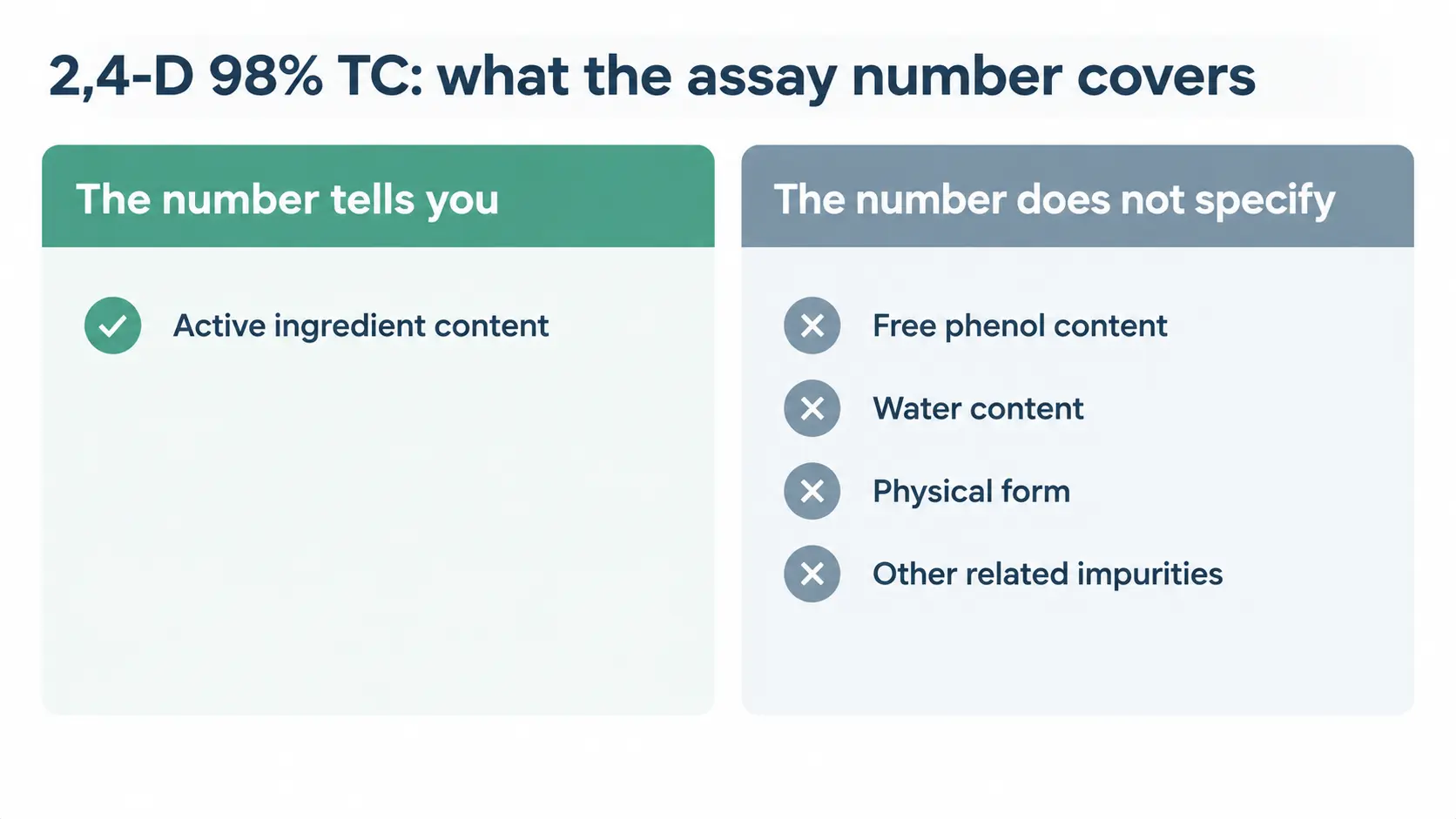
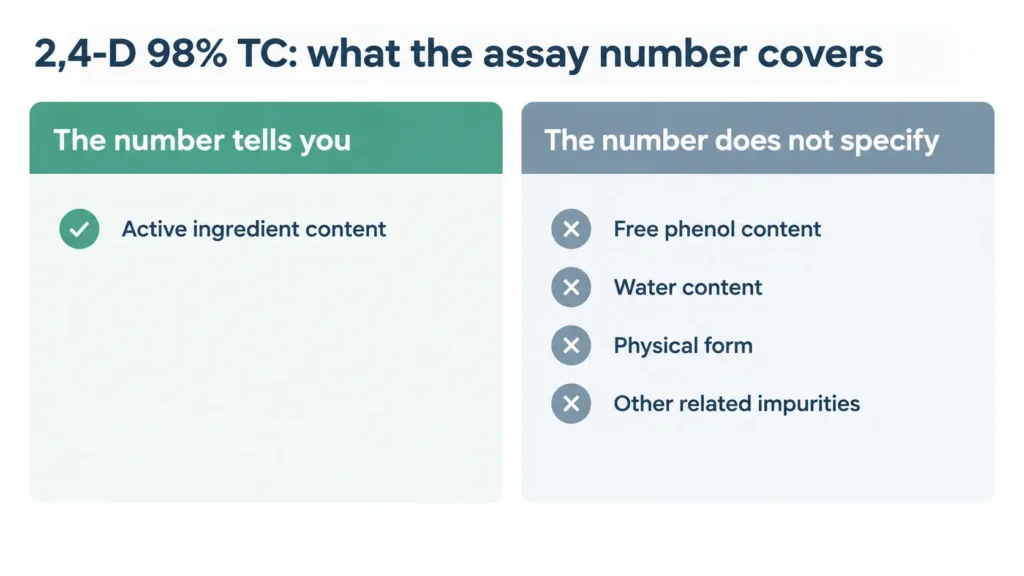
Two suppliers can both quote “98% TC” and ship materially different material. The assay number describes one property — how much active acid is present. It says nothing about the residual phenol left from synthesis, the water the product is carrying, or the physical form it arrives in. Those are the variables that decide whether the batch runs cleanly through your formulation line, and whether it still assays at 98% six months after it lands.
1. "98% TC" is a headline, not a specification
Technical concentrate — TC — is the raw active material before any formulation step. “98%” is the declared active content. Both parts matter, but together they still describe only one dimension of the product.
A specification is a set of limits, not a single figure. When a purchase order says only “2,4-D 98% TC”, it fixes the assay and leaves everything else open: what free phenol is permitted, how much water is acceptable, whether the material arrives as powder or flake, and what the impurity profile looks like.
What is not written into the purchase order is not in the contract. If a batch arrives at 98.2% assay but with free phenol at the top of the permitted band and elevated moisture, it still complies with the order you placed.
2. What a technical grade actually declares
The international reference for this material is the FAO specification for 2,4-D technical material. Its current version sets three things that matter to a buyer.
| Parameter | Requirement |
|---|---|
| 2,4-D content | Declared by the manufacturer, and not less than 960 g/kg |
| Free phenols | Maximum 3 g/kg, calculated as 2,4-dichlorophenol |
| Description | White to brown crystals, granules, flakes, powder or lumps with faint phenolic odour; free from visible extraneous matter and added modifying agents |
Who the specification applies to
One point is routinely missed. The FAO specification was developed from data submitted by specific manufacturers, and states plainly that it does not necessarily apply to nominally similar products from other manufacturers, nor to material produced by a different route.
That has a practical consequence: “FAO specification” on its own is not a quality claim. It becomes meaningful when it names whose technical material was evaluated, or when the supplier can show batch data that matches the limits.
3. Free phenol: the line that reveals process quality
Free phenol is the 2,4-dichlorophenol left over when the synthesis does not go to completion, or when purification is not thorough enough. It is measured as 2,4-dichlorophenol and reported on every competent certificate of analysis.
FAO sets the limit at 3 g/kg. Free phenols are restricted because residual chlorophenol can taint neighbouring crops and foodstuffs.
Free phenol is the best single indicator of how well the batch was purified. A number well inside the limit suggests a controlled reaction and adequate work-up. A number sitting at the ceiling suggests the opposite — and usually comes with wider variation from batch to batch.
For a buyer, the practical rule is simple: if a certificate of analysis does not report free phenol at all, the document is incomplete regardless of how good the assay looks.
4. Water content and storage behaviour
Water is the parameter buyers most often forget to specify. It does not appear in the headline number, and it is rarely the first thing anyone checks on arrival — but it governs how the material behaves in storage and in your own process.
What moisture does to a technical grade
Moisture promotes caking and lumping in bagged material, which turns a free-flowing powder into something that has to be broken up before it can be weighed or charged to a reactor. It also shifts the assay: a product declared at 98% on a dry basis will read lower if it has picked up water in transit.
For shipments into hot, humid climates, moisture pick-up between the plant and the customer’s warehouse is a real route of loss. Two controls make the difference — the moisture limit written into the purchase order, and the packaging.
Packaging is part of the specification
Technical material is normally supplied in 25 kg bags or fibre drums. Where humidity is a concern, the inner liner matters as much as the outer pack: a lined bag restricts moisture ingress in a way an unlined one does not. Our standard supply for solid grades uses a 25 kg bag or fibre drum, and the liner type can be specified. 2,4-D 98% technical material.
5. How to read a certificate of analysis
A certificate of analysis is only useful if it is read against the specification you actually ordered. Five checks cover most of the risk.
On our own supply, every batch is released against in-house HPLC and GC results before shipment, and pre-shipment inspection by SGS, Bureau Veritas or Intertek can be arranged on request, with photographs and a sealed retention sample. Contact our technical team.
Ask for a retention sample
A sealed retention sample held by the supplier is the cheapest dispute-resolution mechanism available. If a batch is questioned on arrival, an independent laboratory can test both sides against the same retained material. Ask for it before the container ships, not after a problem appears.
6. Five-batch analysis and batch consistency
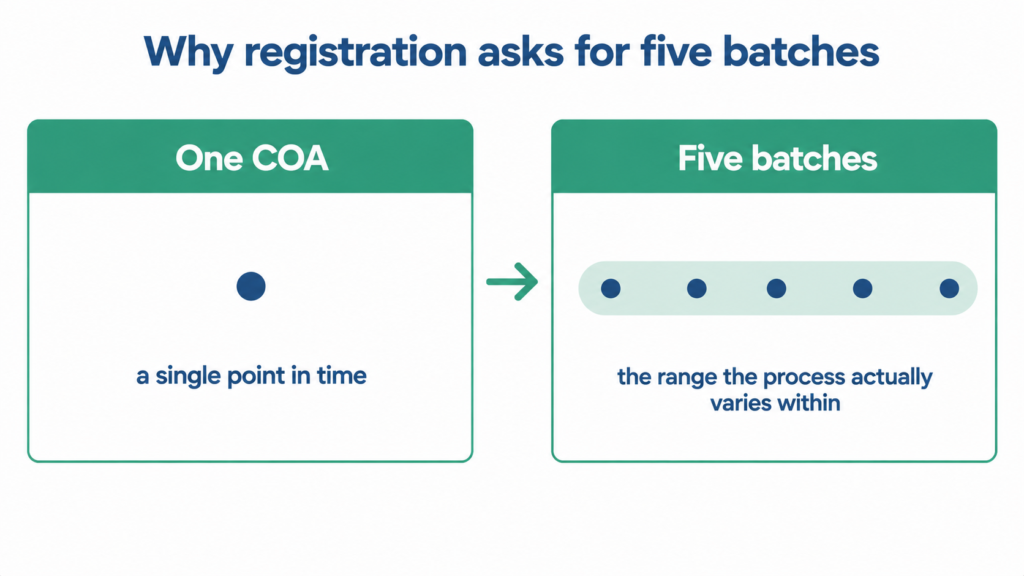
A single certificate of analysis describes one point in time. It answers the question “did this batch pass?” It does not answer the question registration authorities actually ask: “what is the normal range of this product?”
Registration dossiers require analytical data from a series of consecutive production batches, so the impurity profile can be established as a range rather than a spot reading. One certificate proves a batch was inside limits. Five certificates show how far the process drifts between batches — which is what a registration reviewer needs in order to set a defensible specification.
What to ask for
- Analysis of consecutive batches — not a selection of the best ones
- Results presented as a range, with the minimum and maximum for each parameter
- The same analytical method across all batches, so the numbers are comparable
- Impurity data, not only the active content
This is the documentation that accompanies a registration submission, alongside the free-sale certificate, MSDS, TDS and label artwork. If your registration is still ahead of you, it is worth confirming the supplier can produce five-batch data before you commit to the first order rather than after.
7. What to write into a purchase order
Everything above converts into one page of purchase-order clauses. This is the part that actually protects you.
| Clause | What to write |
|---|---|
| Active content | Minimum assay, with the analytical method named |
| Free phenol | Maximum limit, calculated as 2,4-dichlorophenol |
| Water content | Maximum, stated on the same basis as the assay |
| Physical form | Powder, flake or granule — state which |
| Packaging | Pack size and liner type |
| Documentation | Certificate of analysis per batch, retention sample held |
| Inspection | Whether third-party pre-shipment inspection is required |
Two of these are routinely left out and cause most of the avoidable trouble: free phenol, because buyers assume the headline assay covers it, and liner type, because packaging is treated as a logistics detail rather than a technical one.
If you need technical material for formulation rather than a finished product, the same logic carries into the choice of salt or ester — see the 2,4-D form comparison for how the three forms differ, or go straight to the two most common downstream products: 2,4-D DMA salt 720 g/L SL and 2,4-D sodium salt 85% SP.
Next step
Send us the specification you need to meet — active content, free phenol limit, water limit, physical form and destination port. We will confirm what we can supply and quote within one business day, with the batch documentation attached. request the 2,4-D 98% TC product sheet.
Sources
Specification limits are taken from the published FAO specification for 2,4-D technical material.
FAO — Specifications and Evaluations for Agricultural Pesticides: 2,4-D, Technical Material, FAO Specification 1/TC (November 2023)