On this page
Formulation choice is a physical-chemistry decision, not a marketing one. The same 2,4-D molecule behaves very differently depending on which form you ship. Importers who compare products by label concentration alone are comparing the wrong numbers — and often paying more per unit of active acid than they need to.
1. Why one active ingredient is sold in four forms
2,4-D is a phenoxyacetic acid herbicide. Its molecule carries a carboxylic acid group, and the hydrogen on that group can be replaced by a base to form a salt, or reacted with an alcohol to form an ester.
That substitution changes nothing about what happens inside the plant. The parent acid is the species that binds the target site and causes death. The salt or ester is purely a carrier — added because the parent acid is poorly soluble in water and cannot cross the waxy cuticle on a leaf surface on its own.
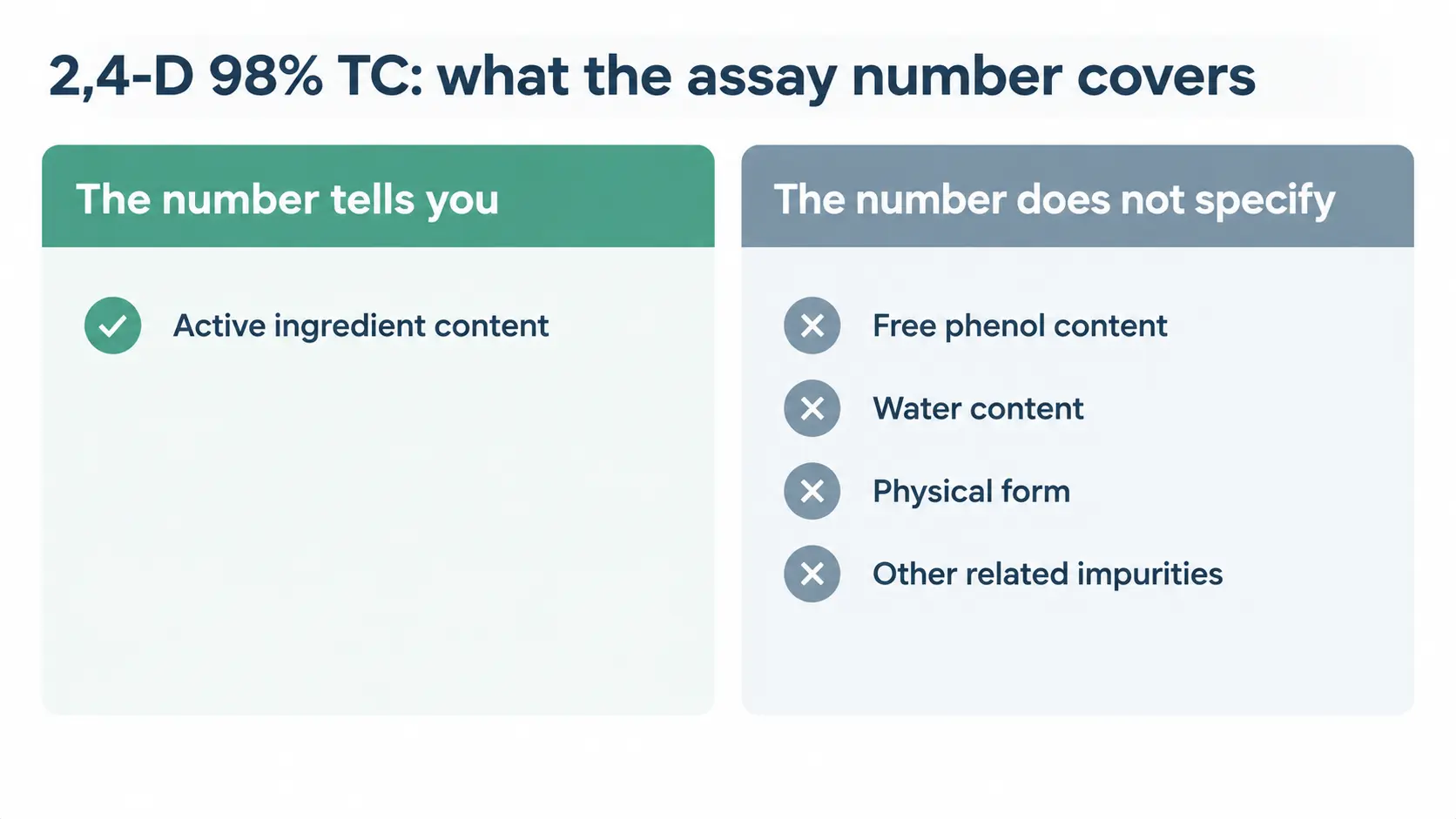
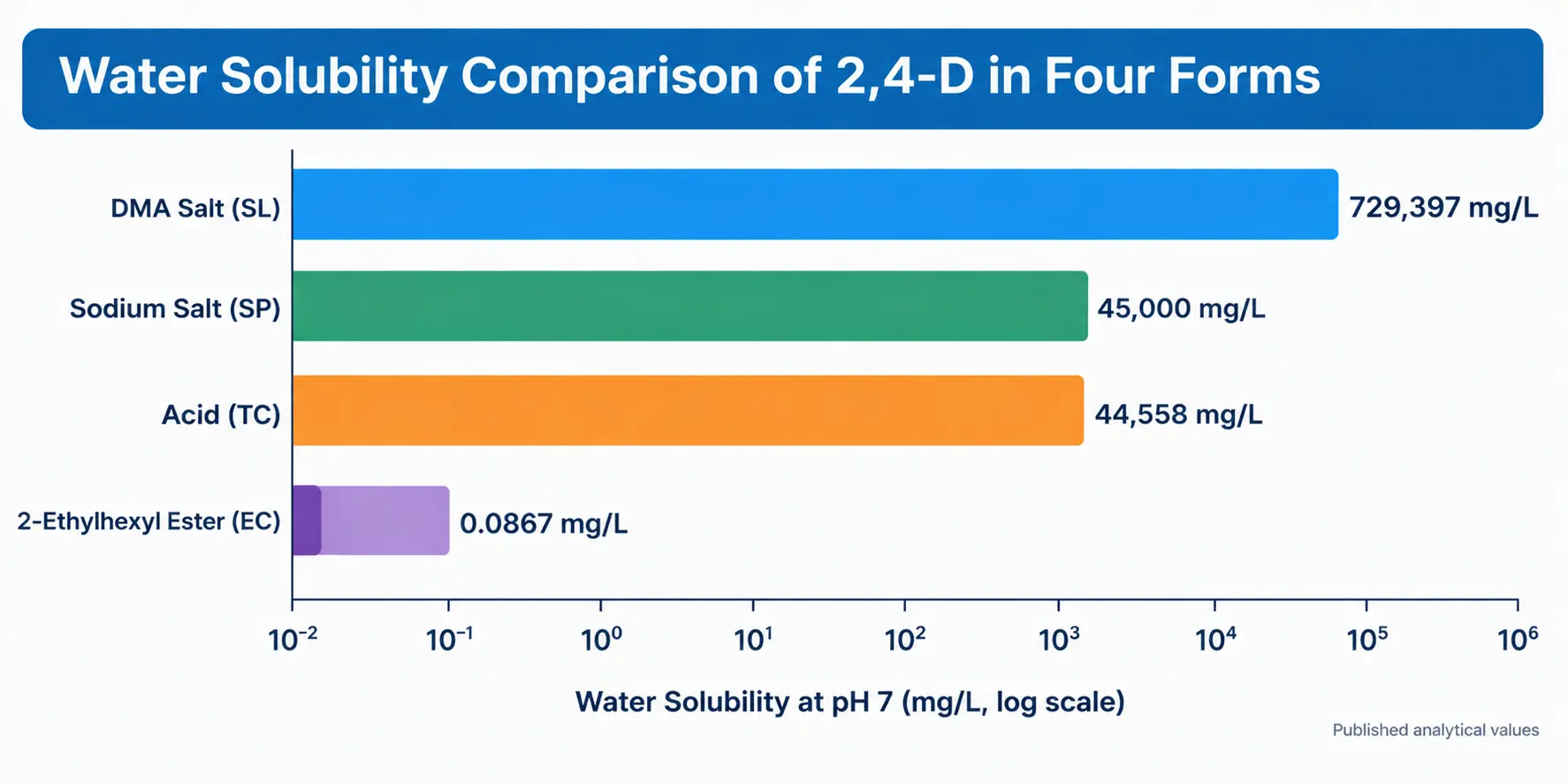
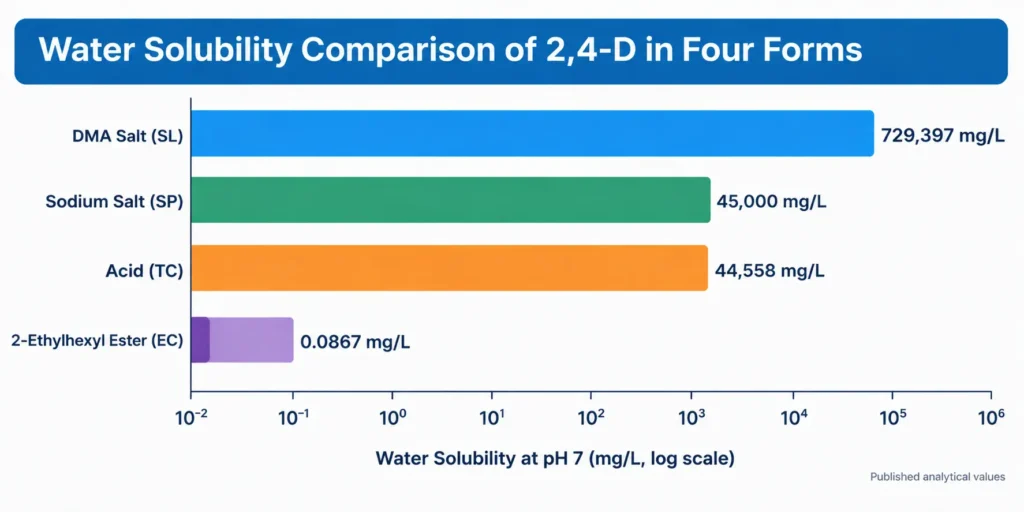
This is the single most useful thing to understand about 2,4-D sourcing. The acid is a white crystalline solid at around 44,558 mg/L solubility at pH 7 and almost no vapour pressure. Neither figure works for field application, so the industry converts it. If you are buying technical material rather than a formulated product, the same logic applies at the raw-material stage — see our 2,4-D 98% technical material
The acid equivalent trap
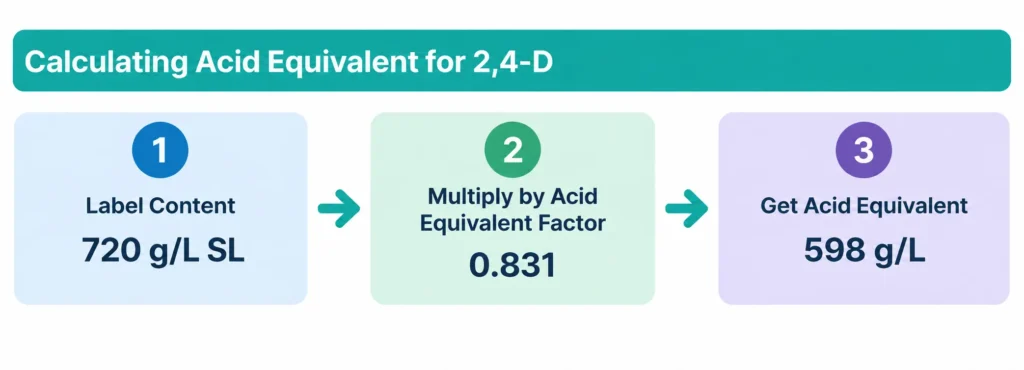
Because the label number includes the weight of the carrier as well as the acid, 720 g/L and 900 g/L are not directly comparable. Converting to acid equivalent (AE) is the only apples-to-apples basis:
The conversion
AE factor = molecular weight of 2,4-D acid (221.04) ÷ molecular weight of the commercial form
The four factors are 1.000 for the acid, 0.831 for the dimethylamine salt, 0.663 for the 2-ethylhexyl ester and 0.910 for the sodium salt. Hold on to those four numbers — they decide most of the purchasing questions below.
2. The four forms at a glance
| Form | Formulation | Solubility, pH 7 | Vapour pressure, 25 °C | AE factor |
|---|---|---|---|---|
| 2,4-D acid | 98% TC | ≈ 44,558 mg/L | 1.4 × 10⁻⁷ mmHg | 1.000 |
| Dimethylamine salt (DMA) | 720 g/L SL | ≈ 729,397 mg/L | 1.0 × 10⁻⁷ mmHg | 0.831 |
| 2-ethylhexyl ester | 900 g/L EC | 0.0867 mg/L | 3.6 × 10⁻⁶ mmHg | 0.663 |
| Sodium salt | 85% SP | ≈ 45,000 mg/L | not applicable (solid) | 0.910 |
The result that changes how you buy
Apply the AE factors to the two most common formulations:
Two products labelled 20% apart carry the same amount of acid equivalent per litre. The real differences are cost per litre of product, cost per litre of spray solution, and how much volume you have to ship.
Compare landed cost per kilogram of acid equivalent — not the number on the label.
Our current range covers all three: our 2,4-D DMA salt 720 g/L SL , 2,4-D isooctyl ester 900 g/L EC and 2,4-D sodium salt 85% SP .
3. Amine form: dimethylamine salt
Physical properties
The dimethylamine salt is the workhorse water-soluble form. At pH 7 its solubility reaches roughly 729 g/L, which means it dissolves completely into the spray tank with no emulsifier system required.
Its vapour pressure of 1.0 × 10⁻⁷ mmHg is the lowest of all four forms.
What importers need to know
That low vapour pressure is the reason amine formulations are preferred next to sensitive crops. The ester sits around 36 times higher — still very low by comparison with common solvents, but a meaningful difference when vapour drift is a concern.
The trade-off sits in the cuticle. Amines are water-soluble, so they sit on the leaf surface rather than dissolving into the wax layer. Esters, being lipid-soluble, penetrate more readily. In practice this means the amine can underperform in cool or dry conditions when the plant is not actively growing.
Two handling points matter in practice. First, amine salts can precipitate in hard water, so a jar test is mandatory before tank-mixing with liquid fertilisers such as UAN. Second, once absorbed the amine acts faster in the plant than the ester, even though uptake is slower.
Our dimethylamine salt is supplied as a soluble liquid concentrate, in HDPE bottles, 200 L drums or 1000 L IBC to your pack specification. our 2,4-D DMA salt 720 g/L SL
4. Ester form: 2-ethylhexyl ester
The ester is sold under both names — 2-ethylhexyl ester (EHE) and isooctyl ester — and both search terms lead to the same product.
Physical properties
Its solubility of 0.0867 mg/L means it is effectively insoluble in water, which is why the 900 g/L EC form depends entirely on an emulsified delivery system.
That same lipid affinity is the reason it works so well: the ester dissolves into the cuticular wax, penetrates faster than the amine, and delivers what the industry calls a “hotter” result.
The crop-injury trade-off
Hotter means more active, and more active means more crop-injury risk when the wrong form meets a sensitive crop. Rapid uptake can temporarily overwhelm the plant’s own detoxification.
This is why ester formulations are restricted in crops such as rice — and why form choice is a regulatory question, not only a performance one.
Esters also resist rain better than amines, because they are already inside the cuticle within a short interval. That widens the usable application window — though the specific figures are set by each destination country’s label, and we do not quote them here.
Our 2-ethylhexyl ester is supplied as 900 g/L EC. 2,4-D isooctyl ester 900 g/L EC
5. Sodium salt form: solid concentrate
The sodium salt is sold as an 85% water-soluble powder, and it is the only solid form among the three. That difference drives most of its commercial advantages.
Physical properties
Its AE factor of 0.910 is the highest of the four forms — a given weight of product contains more actual acid than any other. Its solubility of about 45 g/L is roughly 16 times below the amine salt, but still hundreds of thousands of times above the ester.
What it means for shipping
For importers the practical advantages are transport and storage: no solvent, no flammability handling burden, no emulsion system, and a higher acid loading per kilogram shipped. 2,4-D sodium salt 85% SP
Because the sodium salt is also registered as a plant growth regulator at lower concentrations — a different use pattern from broadleaf weed control — the certificate you need depends on the intended use, not only on the active ingredient.
Buyers supplying a growth-regulator application need a different registration from buyers supplying a herbicide. Check which one your certificate actually covers.
6. How to choose
Work through these in order:
7. Market access and mode of action
Check the form, not just the active ingredient
A registration certificate is issued per active ingredient plus concentration plus formulation. A 720 g/L SL certificate does not authorise a 900 g/L EC product, and neither authorises an 85% SP. Importers sourcing across several forms need a certificate for each.
Status also differs by market. We cannot tell you what your destination permits — that has to be checked against the current list in force in your country before you commit to a shipment. For every order we supply the documentation your submission needs: free-sale certificate, five-batch analysis with impurity profiles, MSDS, TDS and label artwork. See our Registration & Market Access guides→for how to verify these requirements.
Rotation, and why mode of action matters
2,4-D belongs to HRAC group O (WSSA group 4), the synthetic auxins. MCPA sits in the same group — which means rotating between the two offers limited resistance-management benefit, since the target site is unchanged. For what MCPA is actually used for, and how it differs from 2,4-D in weed spectrum, low-temperature performance and crop selectivity, see how MCPA differs from 2,4-D.
A genuine rotation requires a different mode of action. Glyphosate is HRAC group G (WSSA group 9) and provides that alternative: glyphosate as an alternative mode of action.
One residual note: 2,4-D has a soil half-life of roughly six days and negligible residual activity. Where extended control is needed, combine it with a product of a different mode of action.
Browse our full herbicide range for the complete line, or all herbicide product guides
8. Quick reference for a spec sheet
Fields to copy into a specification sheet
| Field | Dimethylamine salt | 2-Ethylhexyl ester | Sodium salt |
|---|---|---|---|
| AE factor | 0.831 | 0.663 | 0.910 |
| AE per litre or kg | ≈ 598 g/L | ≈ 597 g/L | ≈ 773 g/kg |
| Formulation code | SL | EC | SP |
| Choose when | sensitive crops nearby, low vapour risk | cool conditions, faster uptake | solid handling, freight efficiency |
Next step
Send us the active ingredient, formulation, concentration, pack size and destination port. We quote within one business day, with the registration-support documentation attached. Contact our technical team.
Sources
Physical property values — water solubility, vapour pressure, molecular weight — are published analytical values.
National Pesticide Information Center, Oregon State University — 2,4-D Technical Fact Sheet