On this page
Two ECs can hold the same active at the same concentration and behave completely differently in a spray tank. The difference is not in the active — it is in the solvent and the emulsifier package, neither of which appears on the label. That is why an EC has to be judged twice: once as a concentrate in the drum, and once as an emulsion after dilution.
1. What is actually in the drum
An emulsifiable concentrate is a solution, not a mixture. Three components, working together:
- The active ingredient, dissolved — not suspended. An EC only works if the active stays fully in solution across the temperature range the product will meet.
- The solvent, which carries the active and is itself insoluble in water. This is what makes the formulation an oil phase.
- The emulsifier package, which does nothing at all in the drum and everything the moment water is added.
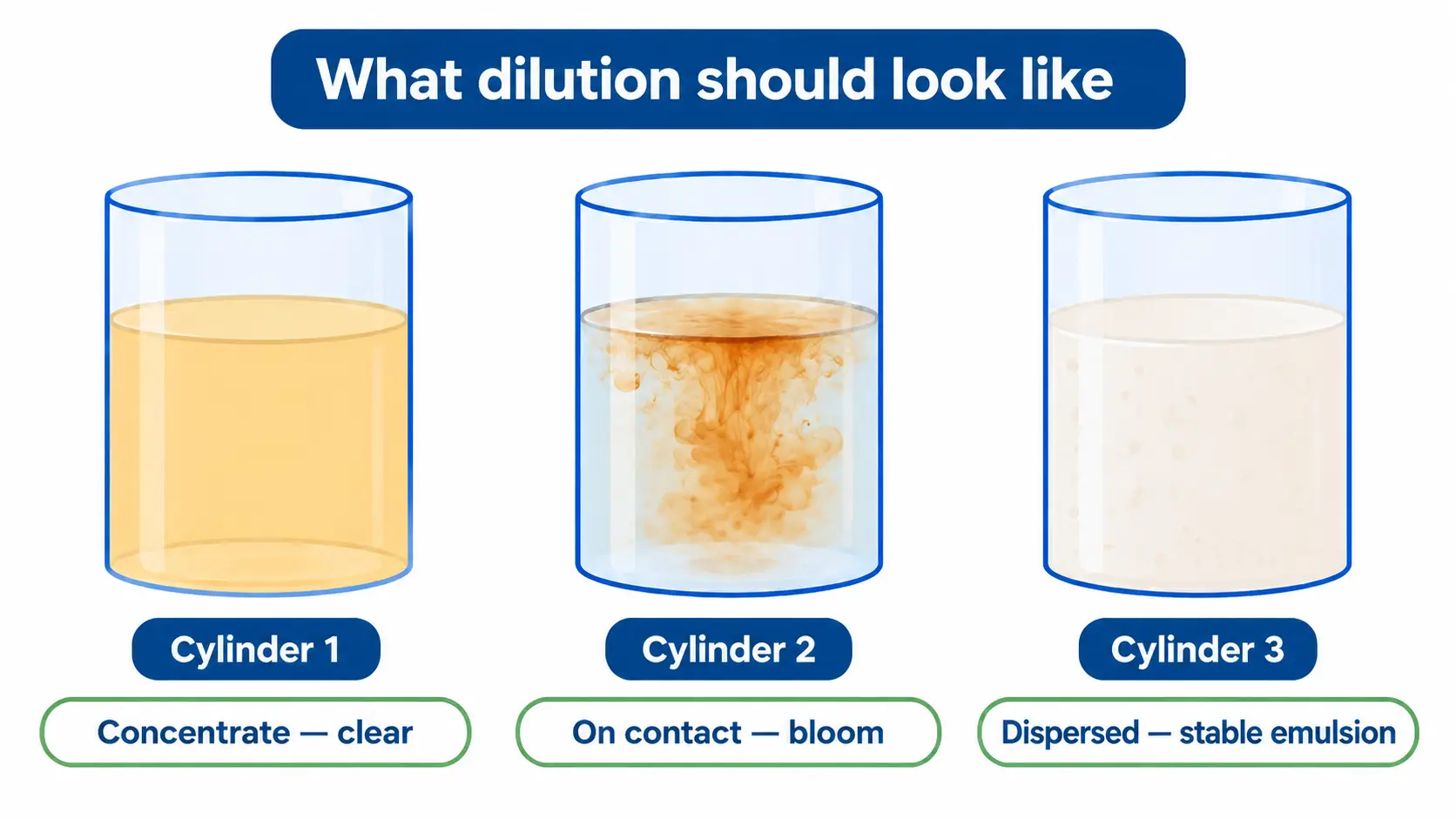
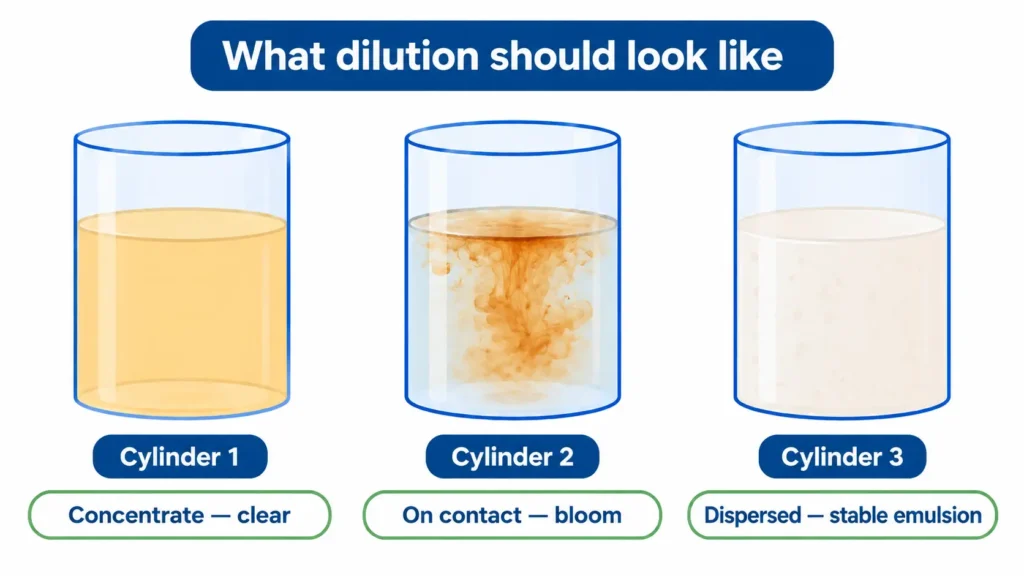
The concentrate looks identical whether the emulsifier package is right or wrong. A clear amber liquid tells you the active is properly dissolved. It tells you nothing about whether that liquid will disperse in the customer’s water.
Compare that with a soluble liquid. In an SL, the active is already dissolved in water, so dilution is just further dilution — there is nothing to disperse. In an EC, the active is dissolved in oil, and dilution is a phase change: the oil must be broken into droplets and held apart. Our 2,4-D isooctyl ester 900 g/L EC.
That is the whole reason the emulsifier exists, and the reason an EC has a failure mode an SL simply does not have.
2. The bloom: what should happen on contact with water
Pour an EC into water and something should happen immediately, without stirring: the concentrate streams off the bottom, then disperses into a uniform milky cloud. The industry calls it the bloom.
The bloom is the emulsifier package doing its job — arranging itself at the boundary between the solvent droplets and the water, so that droplets form, stay small, and stay apart. Done properly, the result is an oil-in-water emulsion with droplets measured in fractions of a micrometre.
A formulation that only emulsifies under strong agitation is a formulation that will fail in a half-filled tank. The bloom has to happen on its own, because that is how the product actually gets used in the field.
What good looks like
Uniform milky appearance throughout the tank, no streaking, no oily film on the surface, no droplets clinging to the tank wall. The colour will be lighter than the concentrate because the oil phase is now finely dispersed rather than continuous.
3. Reading an emulsion: cream, free oil, and what each means
An emulsion that fails does not usually fail dramatically. It fails slowly, and in two recognisable ways.
Both show up downstream as the same set of symptoms: blocked filters, uneven application, and patches of the field that received less active than intended. By the time those appear, the cause is two steps back.
How the standard test reads it
The reference method is CIPAC MT 36.3. It dilutes the formulation in standard test waters — a soft water and a hard water — at both the highest and lowest recommended use rates, then reads the sample for cream and free oil at short intervals after mixing, and checks whether the emulsion re-forms after standing. The test is normally repeated after accelerated storage, because an emulsifier package that works when fresh may not work after a season in a warehouse.
Emulsifier systems are stressed by water hardness, and a formulation that passes in soft water can cream in hard water. That is why the standard runs both. A supplier who only shows you a soft-water result has shown you half the data.
4. Cold: crystallisation is the EC-specific failure
This is where an EC behaves completely differently from an SL. An SL that freezes can be thawed and remixed — the active is dissolved in water and goes back into solution.
An EC has a harder problem. The active is held in solution by the solvent, and solubility falls as temperature drops. At some point the solvent can no longer hold it, and the active comes out as solid crystals — not ice, but the active ingredient itself.
Once the active has crystallised, warming and mixing may redissolve it — or may not, completely. And crystals that form during storage are not the only risk: they can also form after dilution, in the spray tank, where they are far harder to deal with and can block nozzles.
The cold test, and what it is checking
The standard approach holds the sample at low temperature for a defined period and then looks for separated solid or liquid. The acceptance condition is not just “no crystals” — it is that the original properties return on warming and mixing. That second half is what separates a reversible change from a damaged batch.
Why formulators can make this worse
Adding a polar co-solvent is a common way to keep the active in solution at low temperature. It works in the drum — but the same co-solvent can make the active crystallise on dilution, because the solvent system changes abruptly when it meets water. A formulation optimised only against the cold-storage test can fail in the tank.
5. The solvent side: containers, seals and sprayer parts
An EC contains an organic solvent, and that single fact changes what the product can safely touch.
Containers
Solvents attack some plastics and swell some elastomers. This is why EC packaging is not always the same as SL packaging: a bottle that is perfectly adequate for an aqueous concentrate may soften, craze or permeate when filled with a solvent-based one. Fluorinated HDPE is used for exactly this reason — the fluorination passivates the inner surface so the solvent has far less to work on. packaging options for fluorinated HDPE, drum and IBC supply.
Seals, gaskets and sprayer parts
The same applies downstream, and this is the part buyers forget. Solvents can affect plastics and rubbers in spray application equipment — seals, gaskets, diaphragms and hose linings that were fine with an aqueous formulation may degrade with a solvent-based one. An operator switching from an SL to an EC on the same sprayer is changing the chemical environment of every polymer in the line.
A note on hazard classification
Flash point is largely set by the solvent system, and it is a transport and handling property rather than a performance one. Some standards no longer treat it as a formulation specification clause, on the reasoning that it measures hazard rather than product quality — but national transport requirements still apply, and they apply to the solvent you choose. Ask for the transport classification of the specific product, not of the active ingredient.
6. What to check on arrival
An EC needs a different set of arrival checks from an SL — the concentrate tells you less, so the dilution test carries more of the weight.
For the soluble-liquid counterpart — dilution water, hard water precipitation, tank-mixing with liquid fertiliser — see 2,4-D DMA salt 720 g/L SL: handling and compatibility.
For how the forms compare on acid equivalent and which one is cheaper per kilogram of active acid, see the 2,4-D form comparison.
For formulators buying the raw material rather than the finished EC, 2,4-D 98% technical material covers assay and impurity profile, and 2,4-D sodium salt 85% SP is the solid route where solvent handling is the constraint.
All product guides are collected under herbicide product guides.
Send us the water hardness at your customer’s site and the sprayer equipment in use. We will confirm the emulsifier system suits both, and quote with the transport documents for the specific product. send us your water hardness and sprayer details.
Sources
Formulation behaviour and test methods are drawn from published formulation literature and the standard EC test reference.
Croda Agriculture — Emulsifiable concentrate (EC)