On this page
A household insecticide smoke generator carries two active ingredients, and a competent label states each one separately: 3% and 3%. Buyers read that as a 6% product, or as two actives taking turns. Neither reading survives the first technical question — the two ingredients share one mode-of-action group, and they are paired for different jobs.
1. Two percentages that do not add up to a comparison
Arithmetically, the two figures do sum. Three per cent of one active plus three per cent of another is six per cent of the can by mass, and no honest supplier will tell you otherwise.
The error is not in the addition. It is in treating that six per cent as a number you can hold against another product’s single figure. A single-active 5% product and a two-active 3% + 3% product are not 5 against 6. They are two different arrangements of insecticide, and the arrangement is the thing being sold.
The full declaration on our household insecticide smoke generator reads as two lines for this reason:
| Active | Declared | IRAC | Job in the pair |
|---|---|---|---|
| Tetramethrin | 3% | 3A | knockdown — brings insects down fast |
| Beta-cypermethrin | 3% | 3A | persistence — continues working after the knockdown |
That has a practical consequence at the quotation stage. A supplier who quotes “6% FU” as one number has not answered the question, whether or not the arithmetic is right. Ask for the two figures separately, and ask which of them is doing what.
2. Both actives sit in IRAC group 3A
3 · Sodium channel modulators · 3A · Pyrethroids / Pyrethrins — the active-ingredient list under 3A includes beta-cypermethrin and tetramethrin among roughly forty entries.
IRAC Mode of Action Classification, version 11.5
Two actives in the same subgroup are not two modes of action. If a data sheet, a brochure or a sales email presents the pair as a rotation, or as a way to stay ahead of resistance, the claim is wrong on the classification and a technical buyer will catch it in under a minute.
What the pair actually is: one site of action, two behaviour profiles. Resistance management, where a programme needs it, comes from rotating between groups — and that is a decision about a programme, not about a can. This article is about the can.
3. One knocks down, one finishes
The two pyrethroids are separated by one structural detail: a cyano group at the alpha carbon. Tetramethrin does not have it and is classed as a Type I pyrethroid. Beta-cypermethrin does, which makes it Type II.
That detail is why the label carries two numbers. In its reregistration review of tetramethrin, the US EPA describes the compound as a rapid knockdown agent, and describes what it is paired with in precisely these terms:
“…other active ingredients… more persistent than tetramethrin and provide residual activity against insects not exposed initially.”
US EPA, Reregistration Eligibility Decision for tetramethrin
Read that next to the knockdown description and the design of the product becomes visible. Tetramethrin is there to put insects down quickly — the part of the performance a user notices. Beta-cypermethrin is there for the insects that were not in the room when the smoke passed, or that come out afterwards. Neither is a better ingredient. They answer different questions.
Which is also why “which one is stronger” is not a question with an answer. The honest version is: which of the two jobs does your programme actually need, and is the ratio in front of you weighted for it.
4. What the FU code commits you to
FU is not a description of how the product behaves. It is a formulation code, and it has a definition you can quote back to a supplier:
FU — Smoke generator — “A combustible formulation, generally solid, which upon ignition releases the active ingredient(s) in the form of smoke.”
CropLife International, Technical Monograph N°2, 8th edition (2022)
The same catalogue is the reason this matters. It reserves separate codes for products that genuinely are gases — GA for a gas packed in a pressure container, GE for a product that generates gas by chemical reaction. A smoke generator is neither. It is a solid article that burns and carries active ingredient out on the smoke.
Why a buyer should care about a two-letter code: the formulation type is what appears on the registration dossier and on the label. If a quotation, a proforma or a data sheet describes the product with a code from the gas categories, then the paperwork and the physical product are describing two different things. That mismatch does not surface at the factory. It surfaces at registration, months later, in someone else’s office.
5. Smoke is a delivery method, not a gas
What leaves the can on ignition is airborne particulate — smoke — that disperses through the treated space and settles onto surfaces. That single sentence explains most of the behaviour buyers find inconsistent.
It explains why the label talks about a treated space rather than a treated surface: the delivery is volumetric. It explains why surfaces carry activity after the smoke has cleared: the particulate has to land somewhere. And it explains why two buyers using the same can in different rooms can report different results without either of them being wrong — the can is one half of the system, and the space is the other half.
The practical takeaway is not a method. It is a question to settle before the order: the space each can is intended for is stated on the label, and that stated figure — not a number from a brochure, a chat message or a competitor’s datasheet — is the one your customer will hold you to.
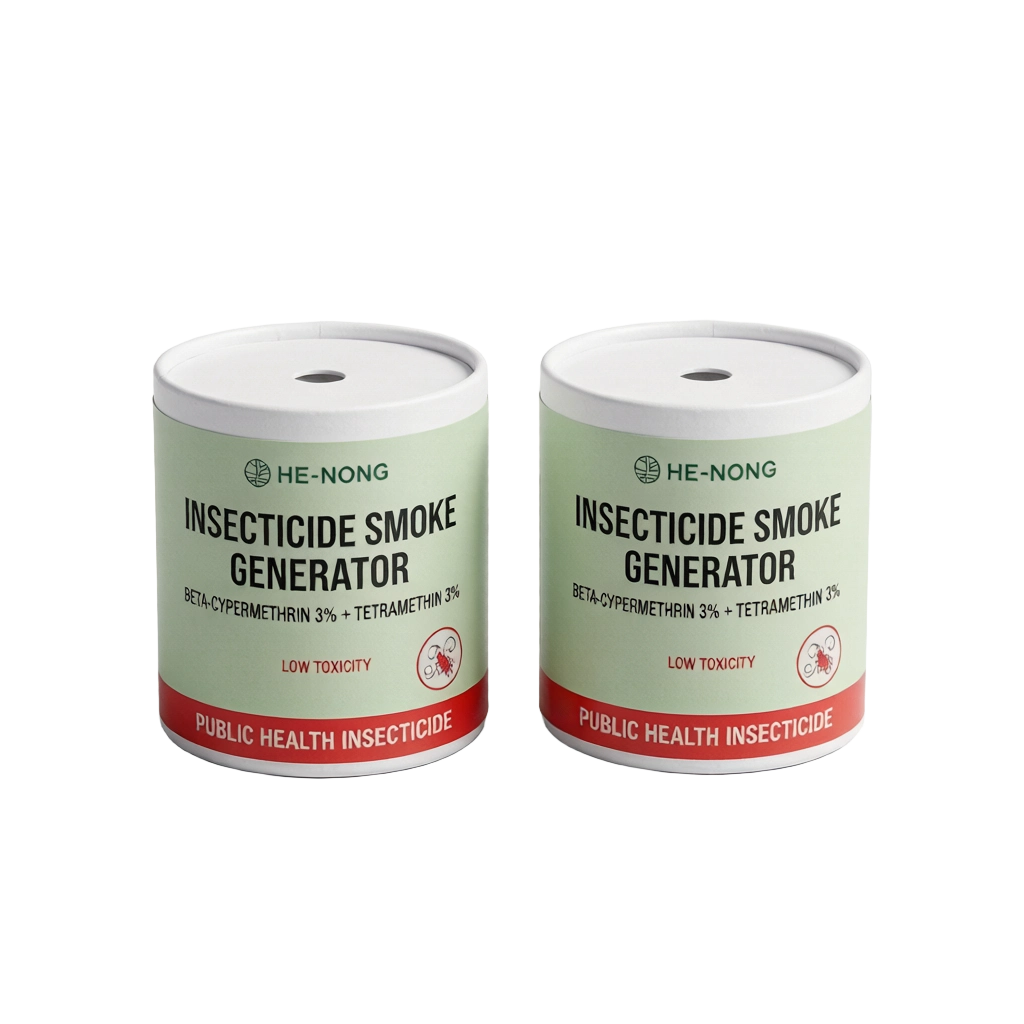
Illustrative packaging. Actual pack size and label artwork to your specification.
6. Six checks when the cartons arrive
A smoke generator is a sealed combustible article, so the acceptance routine is closer to a device than to a drum of liquid. Six checks cover most of the exposure.
Can integrity and seal. A dented, corroded or visibly compromised can is a rejection. Unlike a liquid, you cannot decant it and use the rest.
Net weight per can against the declared figure. Weigh a sample, not the top carton.
Ignition system. Pull-ring or fuse, present on every unit, the same type across the lot, and not loose in the carton.
Consistency across the lot. Open a sample from more than one carton and compare how they burn. A lot that behaves in two different ways is two lots.
Moisture. Cartons that have taken water are a rejection regardless of how the cans look. A combustible article that has absorbed moisture is no longer the article you ordered.
Marking. Declared actives and their percentages, the formulation code, net content, and the registration number printed on the pack — read against the certificate, not against the order email.
The certificate is only useful if you read it against the figures you declared. Reading a certificate against the declared figure sets out the method, and it transfers unchanged from a technical material to a finished formulation.
7. What to put in the RFQ
Two quotations are comparable only if the inquiry closed the ambiguities before anyone answered. Six lines do most of the work.
- Both actives, separately, each with its own percentage. Not a combined figure.
- The formulation code, written as FU. If a supplier answers with a different code, ask why before going further.
- Can weight, and whether that weight is the stock unit or a custom one. Our stock unit is 25 g; other weights are produced to order, and the minimum run is worth settling early.
- Ignition type — pull-ring or fuse — and whether it can be changed for your market.
- Pack format and carton configuration: retail-ready or bulk, and how many cans to the carton.
- Which label items to check, and confirmation of the registration status that applies in your market.
None of the six asks a supplier to disclose anything they would not put in a contract, and all six are things they must know in order to answer at all.
8. When this format wins, and when it does not
This format wins where the constraint is the space, not the target. An enclosed room, a shed, a store, a food-handling area after stock removal: a sealed combustible article treats the volume with no pump, no hose, no dilution and no operator judgement about where to point something. That is a real advantage for a distributor selling to customers who have no equipment and no trained staff.
It loses where the constraint is the target. If the job is a defined harbourage, a crack, a specific surface that needs a defined deposit, a smoke generator is the wrong instrument — not because it is weak, but because it delivers to a volume rather than to a place. Those jobs belong to a different format.
The same plant runs other smoke generators on the same logic for different targets — an agricultural insecticide smoke generator for crop and storage pests, and a fungicide smoke generator for the disease side. Same delivery method, same acceptance routine, entirely different active and entirely different buyer.
Which returns to where this started. The label on the household product carries two percentages because the product does two jobs in sequence, not because it is twice as strong. Read the two numbers as a division of labour and the quotation starts making sense. Read them as a single score and every comparison you make afterwards inherits the error.
More: more smoke generator notes.
Send us the two actives you need declared, the can weight and your pack format, and we will come back with the formulation code, the ignition type and the minimum run — in writing, not in a chat. Tell us your can weight and pack format.
Sources
Three published documents are relied on below. Each is quoted for a specific point, and no claim in this article rests on any of them beyond that point.