On this page
A soluble concentrate is judged by what happens after dilution, not before it. In the drum, 2,4-D DMA salt is a clear amber liquid that looks identical whether it will behave well or badly in the spray tank. The difference only appears once it meets the water your customer actually has — and by then the tank is already mixed.
1. What "SL" means at the drum
SL stands for soluble concentrate: a liquid formulation that forms a true solution when diluted in water. Not an emulsion, not a suspension — a solution, where the active ingredient is dissolved at molecular level and stays dissolved.
That distinction has practical consequences you can see. An EC formulation needs an emulsifier system, and a freshly made EC dilution turns milky because the oil phase is dispersed as droplets. An SL dilution stays clear, because there is nothing to disperse.
Why this matters commercially
No emulsifier means fewer things that can fail. There is no emulsion stability to break, no creaming or oil separation in the drum, and no need for constant agitation to keep the product homogeneous during spraying.
The trade-off is that solubility is finite. The dimethylamine salt dissolves to roughly 729 g/L at pH 7, which is why 720 g/L is the standard commercial loading — the concentrate sits close to its own solubility ceiling. Our 2,4-D DMA salt 720 g/L SL.
That single fact explains most of what follows. A solution that is already near saturation has very little headroom left for anything that reduces solubility — a colder dilution, a harder water, or a tank-mix partner that competes for the same ions.
2. Water quality: the variable nobody writes down
Ask a buyer what water they will dilute with and the answer is usually “whatever is on site”. That is the gap where most compatibility problems start.
Two water properties matter more than the rest:
- Hardness — the calcium and magnesium content. Hard water carries divalent cations that can pair with the 2,4-D anion and take it out of solution.
- pH — affects how the salt behaves in the tank and how it interacts with mix partners.
Neither is visible. Water that looks perfectly clear can be hard enough to cause trouble, and a site that changed its water source — a new borehole, a different municipal supply, a refilled storage tank — can change performance without anyone connecting the two events.
Test with the water at the destination, not with distilled water in a laboratory. A formulation that dilutes cleanly in demineralised water proves nothing about how it will behave in a hard-water site.
3. Hard water and the precipitation problem
Amine salts are water-soluble by design, but solubility is not unconditional. In hard water the salt can come back out of solution — and the sequence is predictable.
How it shows up
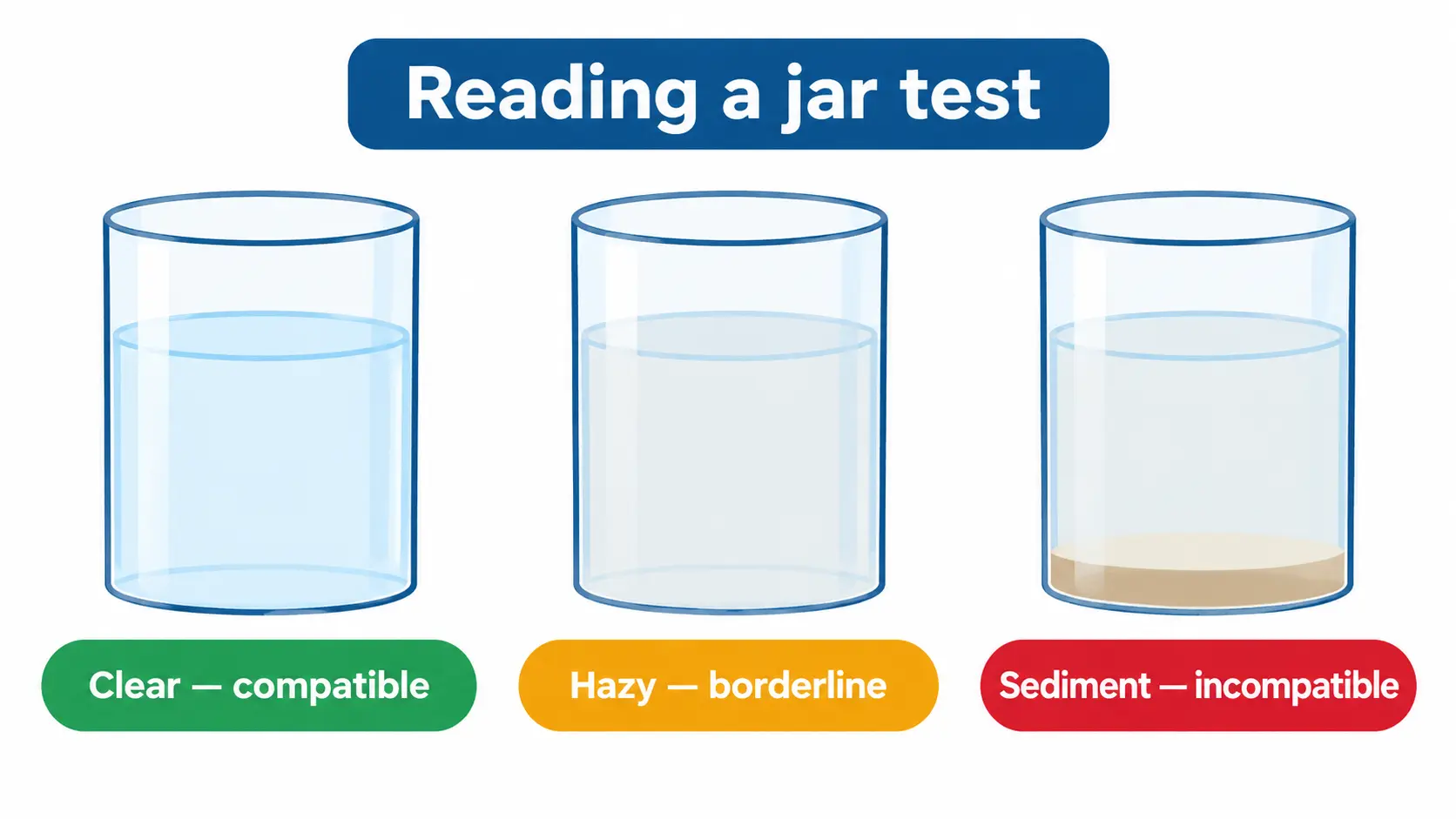
It starts as a faint haze in the spray tank that was not there a minute earlier. Left alone it develops into floc, then sediment. By the time there is visible deposit on the tank floor, filters and nozzles have already been through it.
The commercial damage is twofold: blocked lines cost the operator a day, and whatever precipitated is no longer in the spray solution doing its job. Neither is visible in the drum beforehand.
Formulators already build in a defence
This is not a new problem, and it is worth knowing that most commercial 2,4-D amine products include additives specifically designed to reduce precipitation in hard water. The presence of those additives is one of the things that separates a formulation built for real field water from one built to pass a laboratory dilution test.
Run a jar test with the destination water before the container ships. A clear sample after standing is a good sign. A haze that forms and does not clear is the warning — and it is far cheaper to discover on a bench than in a farmer’s sprayer.
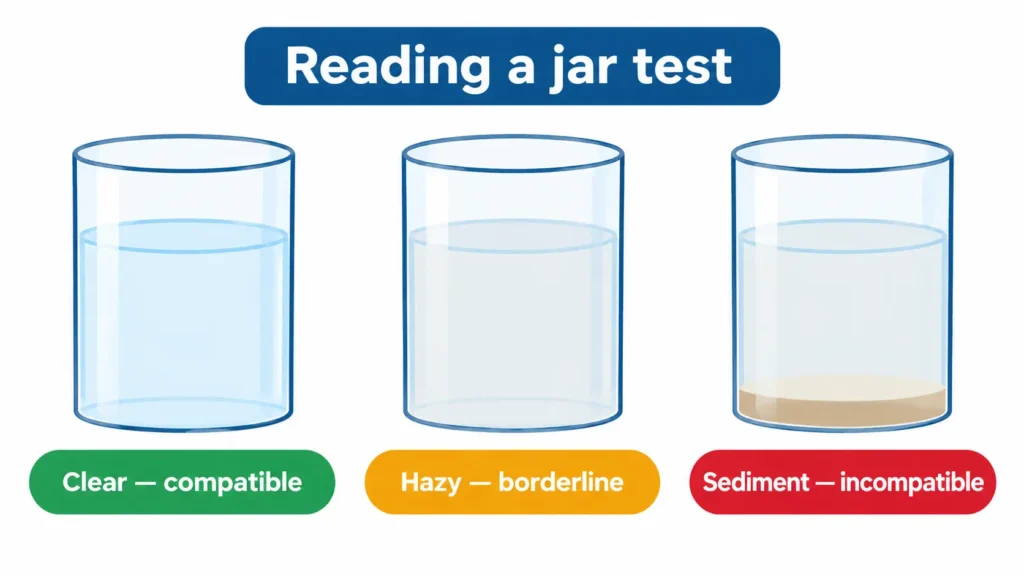
The jar test, done properly
It takes a few minutes and needs nothing more than a clean glass jar and the water in question:
- Use the water the product will actually be diluted with — not a sample from the lab tap
- Mix at the ratio the label specifies for the final spray, not a convenient round number
- Look at the sample immediately, then again after standing
- Repeat with each tank-mix partner added, in the order the operator will add them
Record what you see. A photographed jar test is the cheapest evidence either side can hold if a shipment is later disputed.
4. Tank-mixing with liquid fertiliser
UAN and similar liquid fertilisers are common carriers, especially for burn-down and small-grain work where the operator wants one pass. Mixing an amine salt into UAN is where a lot of otherwise good product goes wrong.
The amine form is generally harder to mix with UAN than the ester form, because it has a higher tendency to come out of solution. That is a property of the salt, not a defect in a particular batch — and it is the reason a jar test is standard practice before committing a whole tank.
One: dilute the product before it meets the fertiliser. Adding concentrate straight into UAN gives the salt a local concentration it cannot hold.
Two: never carry over a result from last season. A different UAN batch, a different water source or a different temperature can change the outcome even when nothing about the product changed.
When a mix does fail, the useful question is not “is the product bad” but “which of the three inputs changed” — water, fertiliser or temperature. Answering that usually resolves the dispute faster than a laboratory assay, because the assay will typically show the product is exactly as specified.
5. Cold, heat and storage
An SL is an aqueous concentrate, which means it responds to temperature the way any concentrated salt solution does.
Freezing
In an unheated container, in transit through a cold corridor, or in a warehouse that is not climate controlled, the concentrate can freeze. Freezing in itself does not normally damage the active ingredient — but it does change the physical distribution inside the drum.
A partially thawed drum is not homogeneous. If someone draws product off the top while the rest is still slush, they are not drawing the formulation that was specified. Let it thaw completely, then mix thoroughly, then use it.
The same applies to a drum that has sat undisturbed for a long time: mixing before drawing a sample is standard practice, because a sample taken from a stratified drum tells you about the top of the drum and nothing else.
Heat
High temperature is the slower problem. Long exposure to direct sun or a hot storefront drives evaporation from any imperfectly sealed container and accelerates the degradation pathways that shorten shelf life. Shade and a sealed closure do more for product condition than any additive.
Packaging
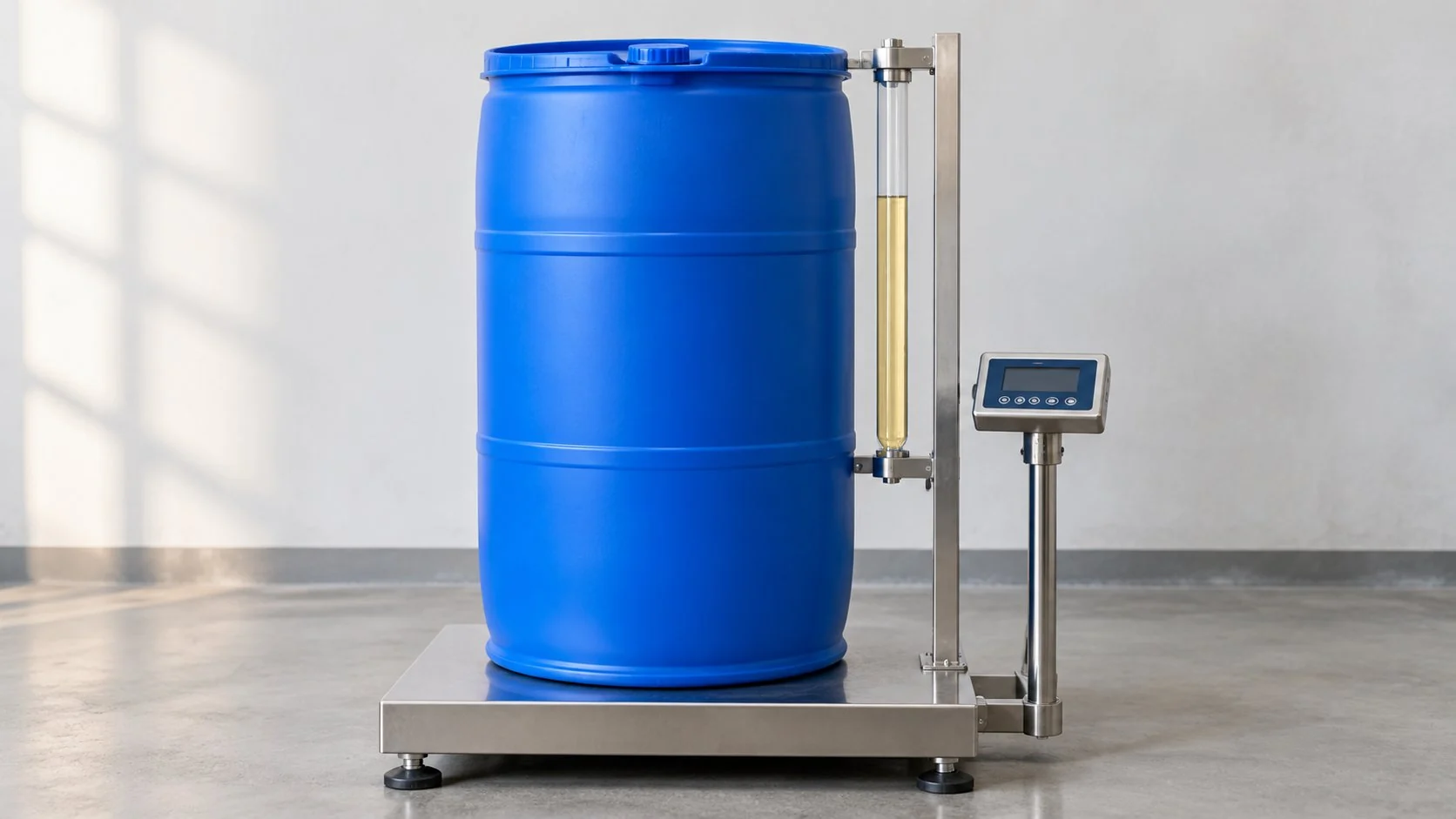
SL is supplied in HDPE bottles, drums and IBCs — all materials compatible with an aqueous salt solution. What matters at the buyer’s end is that the closure stays intact and the container is not stored on its side. packaging options for drum and IBC supply.
6. Checking a drum on arrival
Most of what goes wrong with an SL shipment is visible within ten minutes of opening the container. Four checks cover it.
If the drum arrived frozen, document that before thawing — photographs of the container and the condition of the contents. It is much easier to establish what happened while the evidence is still in front of you.
For how this form compares with the ester and the sodium salt — including the acid equivalent arithmetic that decides which one is actually cheaper per kilogram of active acid — see the 2,4-D form comparison. If you are sourcing the raw material rather than the formulated product, 2,4-D 98% technical material covers the assay and impurity side, and 2,4-D sodium salt 85% SP is the solid alternative where solvent-free handling matters.
Send us your dilution water analysis and the tank-mix partners you intend to use. We will confirm compatibility and quote the loading that suits your market, within one business day. send us your water analysis and tank-mix list.
Sources
Solubility and formulation behaviour are taken from published technical and extension sources.