On this page
If you have specified 2,4-D technical material before, the MCPA sheet will feel like a document you already know. Same structure, same section order, same category of tests. That familiarity is the trap. Three of the numbers differ, and the free-phenol test does not even measure the same compound — it measures a different molecule, with a limit more than three times higher.
1. A sheet that looks familiar
Both products are phenoxyacetic acid herbicides. Both are sold as technical material with a declared content, a water limit, a free-phenol limit and a residue-on-sieve check. Read quickly, the two specifications look interchangeable.
They are not. The differences start at the headline number and run all the way down.
| Parameter | MCPA — FAO 2/TC/S/F | 2,4-D — FAO 1/TC (2023) |
|---|---|---|
| Declared content, minimum | 930 g/kg | 960 g/kg |
| Content tolerance | ± 15 g/kg | Must not fall below declared |
| Free phenols, maximum | 10 g/kg | 3 g/kg |
| Free phenols calculated as | 4-chloro-2-methylphenol | 2,4-dichlorophenol |
| Water, maximum | 15 g/kg | — |
| Sulphated ash, maximum | 10 g/kg | — |
| Triethanolamine insolubles | 1 g/kg on 105 µm | — |
2. Free phenol means a different molecule here
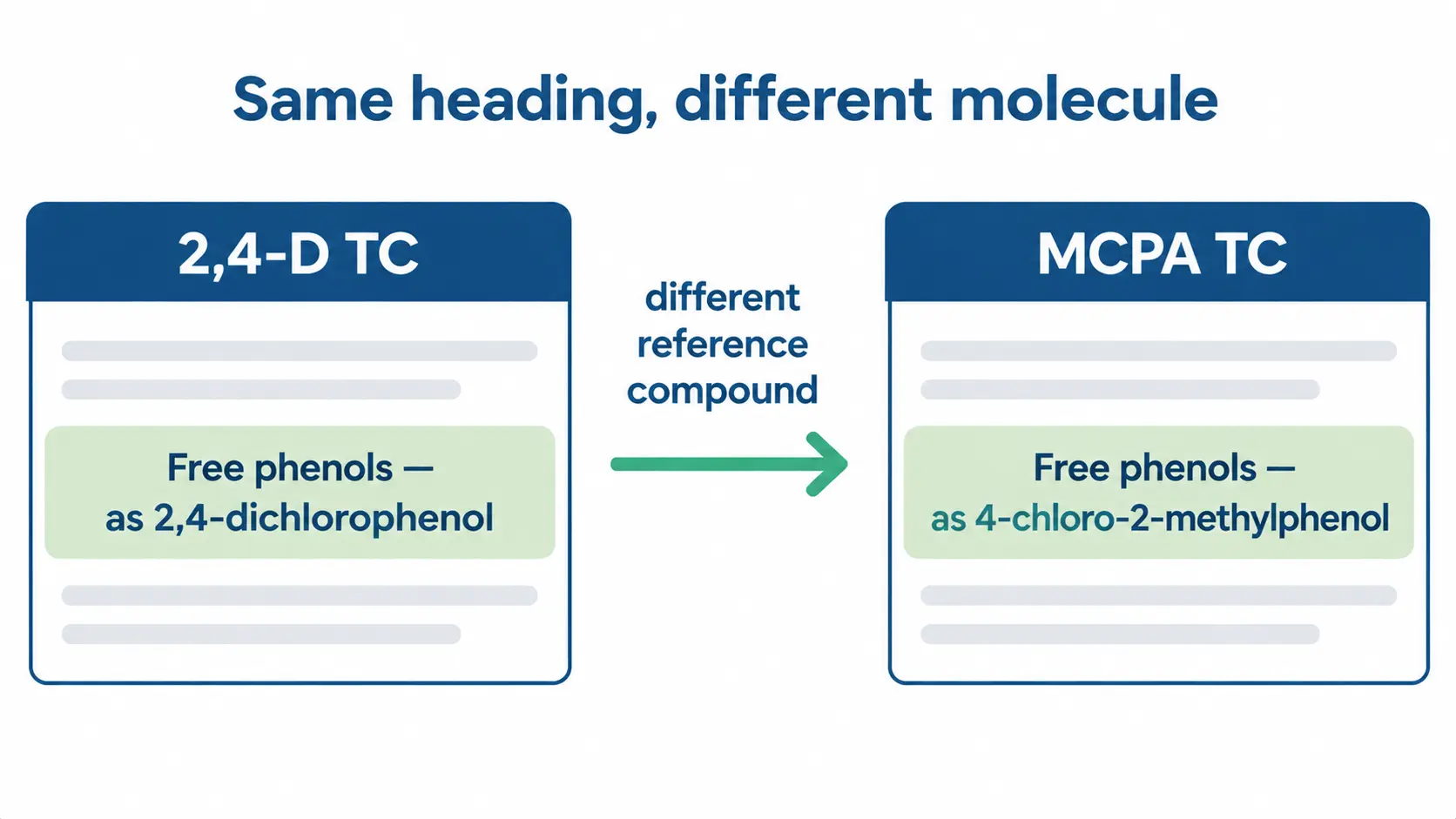
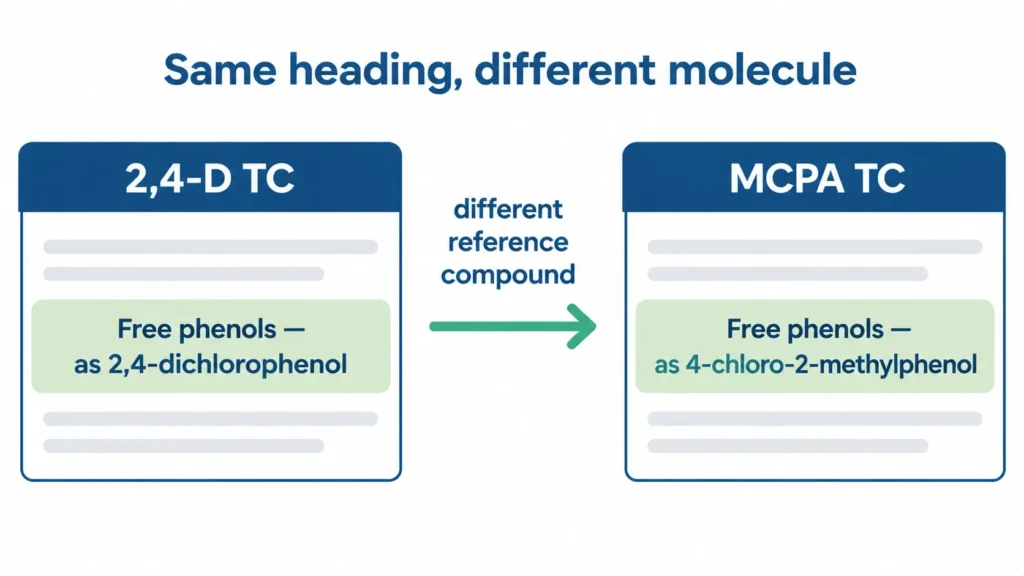
This is the line most likely to be copied wrongly, because the heading is identical in both documents: Free phenols.
In 2,4-D, free phenols are calculated as 2,4-dichlorophenol. In MCPA, they are calculated as 4-chloro-2-methylphenol. These are different compounds with different molecular weights — so the same analytical result expressed against the wrong reference is simply a wrong number.
“Free phenol, max 3 g/kg” copied onto an MCPA order is not a tighter version of the MCPA limit — it is a limit written against the wrong compound. Your supplier will either query it or, worse, sign it and then fail the batch against a test that was never applicable.
3. The rest of the sheet, line by line
Beyond the free-phenol line, three clauses exist in the MCPA specification that have no counterpart in the 2,4-D document. All three are worth knowing about, because all three are things a batch can fail on.
Water — 15 g/kg
Moisture in a technical grade affects how the material stores, how it weighs out, and how it behaves when it is later formulated. In MCPA it is a declared clause with a ceiling; in the 2,4-D specification the equivalent line is absent.
Sulphated ash — 10 g/kg
This measures inorganic residue left after ignition — a proxy for salt content and for how clean the work-up was. It is not a headline number, but it is one of the clauses a registration reviewer will look at when deciding whether the impurity profile is consistent between batches.
Triethanolamine insolubles — 1 g/kg on a 105 µm sieve
A solution of the material in triethanolamine must leave almost nothing on the sieve, and the sieved solution must be clear or only slightly opalescent. This is a coarse-particle check, similar in purpose to the sieve test on a soluble powder: it catches material that will not fully dissolve and will therefore cause trouble downstream.
Each one is a clause your supplier can fail, and each one is a clause your purchase order may not mention. A generic order for “MCPA 95% TC” picks up the content figure and leaves the other three open — which is exactly the gap this article is about.
The gap sharpens once a certificate has to be read against a quotation for a different commercial form of the same active. A limit expressed per kilogram of acid and a limit expressed per kilogram of product are not the same test, even when the numbers printed beside them look similar. Two impurity limits that do not share a denominator takes that case apart.
4. Why the floor is 930 and not 960
The declared minimum for MCPA technical material is 930 g/kg. For 2,4-D it is 960 g/kg. That is not an inconsistency in the standards — it reflects what the two manufacturing routes reliably deliver, and what the analytical methods are designed to measure.
For a buyer, the practical reading is this: 930 g/kg is the floor, not the target. Our MCPA 95% TC sits comfortably above the specification floor, and is declared as such.
“95% TC” tells you what the supplier declares. The certificate tells you what the batch measured. A batch declared at 95% and measured at 95.2% is compliant; a batch declared at 95% and measured at 93.5% is relying on the tolerance rather than the declaration. Both can reach you looking identical.
This is the same principle that governs 2,4-D technical material, and it is covered in more depth — including how to read the certificate against the declared figure — in the 2,4-D technical material guide. The mechanics are identical; only the numbers on the sheet change.
5. The copy-paste error
Put the previous sections together and the risk becomes concrete. Someone preparing an MCPA enquiry reuses a 2,4-D specification document, changes the product name, and sends it. Three things are now wrong, and none of them is obvious on screen.
The fix is not complicated. Specify MCPA against the MCPA reference, keep the three extra clauses in the order, and check that the certificate reports free phenol against the correct compound rather than only reporting a number.
For where MCPA fits against 2,4-D commercially — which crops, which season, which one a buyer should actually order — see the MCPA vs 2,4-D comparison. For the grades downstream of this technical material: MCPA sodium salt 56% SP and MCPA 2-ethylhexyl ester. All technical grades are collected under herbicide product guides.
Send us the specification you are working to and the destination market. We will tell you which clauses are achievable, which need adjusting, and quote the grade with its certificate, within one business day. Send us your MCPA specification for review.
Sources
Both specification sets are quoted from the published FAO documents, each from its own version — no clauses have been carried across versions.