On this page
MCPA and 2,4-D are close enough that they get used interchangeably, and different enough that the substitution sometimes costs a crop. They sit in the same mode-of-action group, are sold in the same formulation types, and are quoted against each other on price. The difference is a single methyl group — and what that group does to selectivity is the only reason MCPA still exists as a commercial product rather than as a footnote to 2,4-D.
1. One methyl group, one fewer chlorine
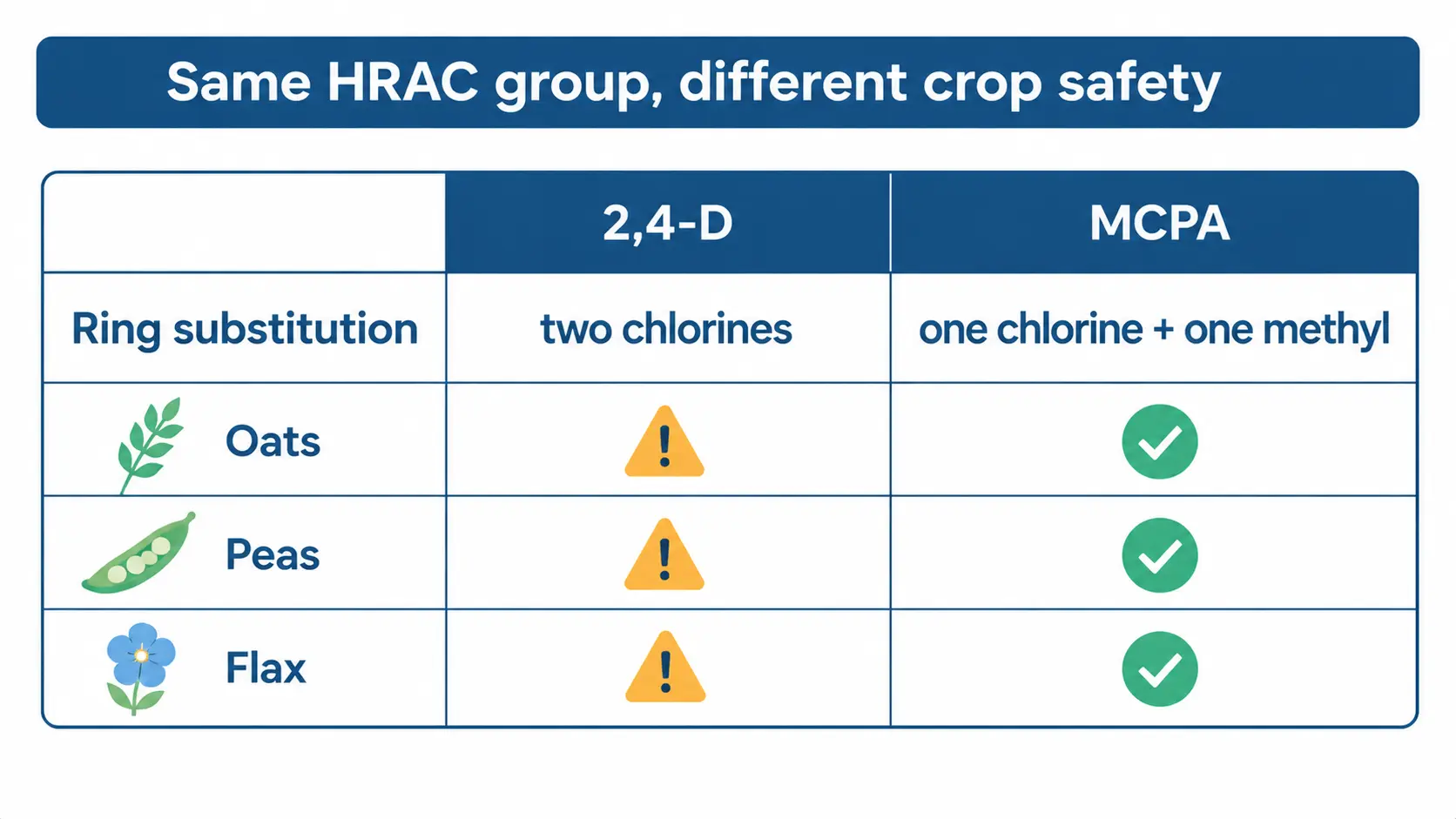
2,4-D is 2,4-dichlorophenoxyacetic acid: two chlorines on the ring. MCPA is 2-methyl-4-chlorophenoxyacetic acid: one chlorine and one methyl group in the positions 2,4-D fills with its second chlorine.
That is the whole structural difference, and it does not change the mechanism. Both are synthetic auxins, both bind the same receptor complex, both produce the same disorganised growth and the same eventual collapse. That is why they sit in the same HRAC group and why the same resistance caveat applies — see the 2,4-D form comparison for what that means when you rotate between them.
It changes how quickly the plant can break the molecule down — and which plants can do it. The herbicidal effect is the same; the metabolic handling is not. That is where selectivity comes from, and it is the only axis on which choosing MCPA over 2,4-D is a technical decision rather than a commercial one.
2. Where that difference earns money
The commercial reason MCPA survives alongside a cheaper, broader-spectrum cousin is crop tolerance in a specific set of crops.
MCPA is the more selective of the two in oats, and it is used on crops that are more easily injured by 2,4-D — peas and flax among them. That is not a marginal difference in a trial plot; it is the difference between a herbicide a grower can use and one they cannot.
If your customer grows oats, peas or flax, MCPA is not a cheaper substitute for 2,4-D — it is the only one of the two they can safely use. Quoting 2,4-D against an MCPA enquiry is not competitive pricing; it is answering a different question.
The same logic applies at the edges of a cereal programme
Where a field sits next to sensitive broadleaf crops, or where a rotation includes them, the margin matters more than the headline activity. A product that is slightly less aggressive on the target weed but noticeably safer on the neighbouring crop is the one that gets ordered again next season.
For importers, this is a positioning point rather than a formulation one. MCPA is not sold on being stronger. It is sold on being the one that does not damage the crop — and the buyers who need that will pay for it.
3. Cold conditions
This is the second practical difference, and the one that shows up in the field rather than in the catalogue.
MCPA performs better than 2,4-D at low temperature. The mechanism is not mysterious: uptake and translocation slow down as temperature falls, and a molecule that the plant metabolises more slowly keeps working for longer at the point where it is needed. In a cold spring, that difference is visible in the weed control, not just in the label.
Cold is not only a temperate-zone problem. Early-season spraying in cooler highland areas, night applications, and unseasonal cold snaps all sit in the range where the two products stop behaving alike. If a customer’s application window is unreliable, this is a real selection criterion rather than a curiosity.
Worth being precise about what this does not mean. It does not make MCPA a cold-weather herbicide in the way that phrase is used in some marketing — it means that, all else equal and at the same timing, it holds performance better as temperature drops.
4. The forms, and two handling quirks
MCPA is supplied in the same family of formulations as 2,4-D, and the same acid-equivalent logic applies — a declared concentration of the salt is not the same as a concentration of acid. What differs is where the handling problems show up.
| Grade | Form | What it is for |
|---|---|---|
| MCPA 95% TC | Technical material | Formulators making their own salt or ester; the raw material behind everything else |
| MCPA sodium salt 56% SP | Soluble powder | Direct use where a solid, solvent-free pack is preferred |
| MCPA 2-ethylhexyl ester | 95% TC / 85% EC | Where cuticle penetration or oil-based delivery is the requirement |
Technical material: MCPA 95% TC.
Sodium salt: MCPA sodium salt 56% SP.
Ester: MCPA 2-ethylhexyl ester.
Quirk one: the salts do not like hard water
MCPA’s alkali-metal and organic-base salts dissolve readily in water — and can be precipitated by hard water. The same divalent-cation problem that affects other phenoxy salts applies here, and it shows up after dilution rather than in the drum.
Quirk two: alkaline solutions attack aluminium and zinc
The salt solutions are alkaline, and in that condition they corrode aluminium and zinc. That is a packaging and equipment point, not a formulation defect: it decides which containers are acceptable, and it decides whether a sprayer’s aluminium fittings are a suitable home for the mix.
A drum of clear salt solution tells you nothing about either. Hard-water precipitation appears in the tank; aluminium corrosion appears a season later, on the equipment. Both are worth asking about before the order, not after.
5. Choosing between them
That last point is the one most often got wrong in a purchasing conversation. Two products from different suppliers at different prices feel like a rotation; two products in HRAC group O are not one.
Tell us the crop, the application window and the form you need. We will confirm which of the two fits and quote the grade, within one business day. Ask which grade fits your crop and season .
Sources
Physicochemical properties and the comparison with 2,4-D are taken from the published technical entry for MCPA.